Trenching and conduit: the line item that sets your per-port price
Trenching for parking lot chargers is priced by what you cut and what you have to put back, not by the foot. The same 150 feet costs one thing through landscape, more through an asphalt bay, more again through structural concrete, and most of all across a drive aisle that has to stay open during business hours and be restored to a paving standard. On a commercial charging project the electrical and civil make-ready commonly outweighs the chargers themselves, which is why this line item sets your per-port price. One instruction saves more money over a decade than any other: pull spare conduit while the trench is open.
Updated 2026-08-20
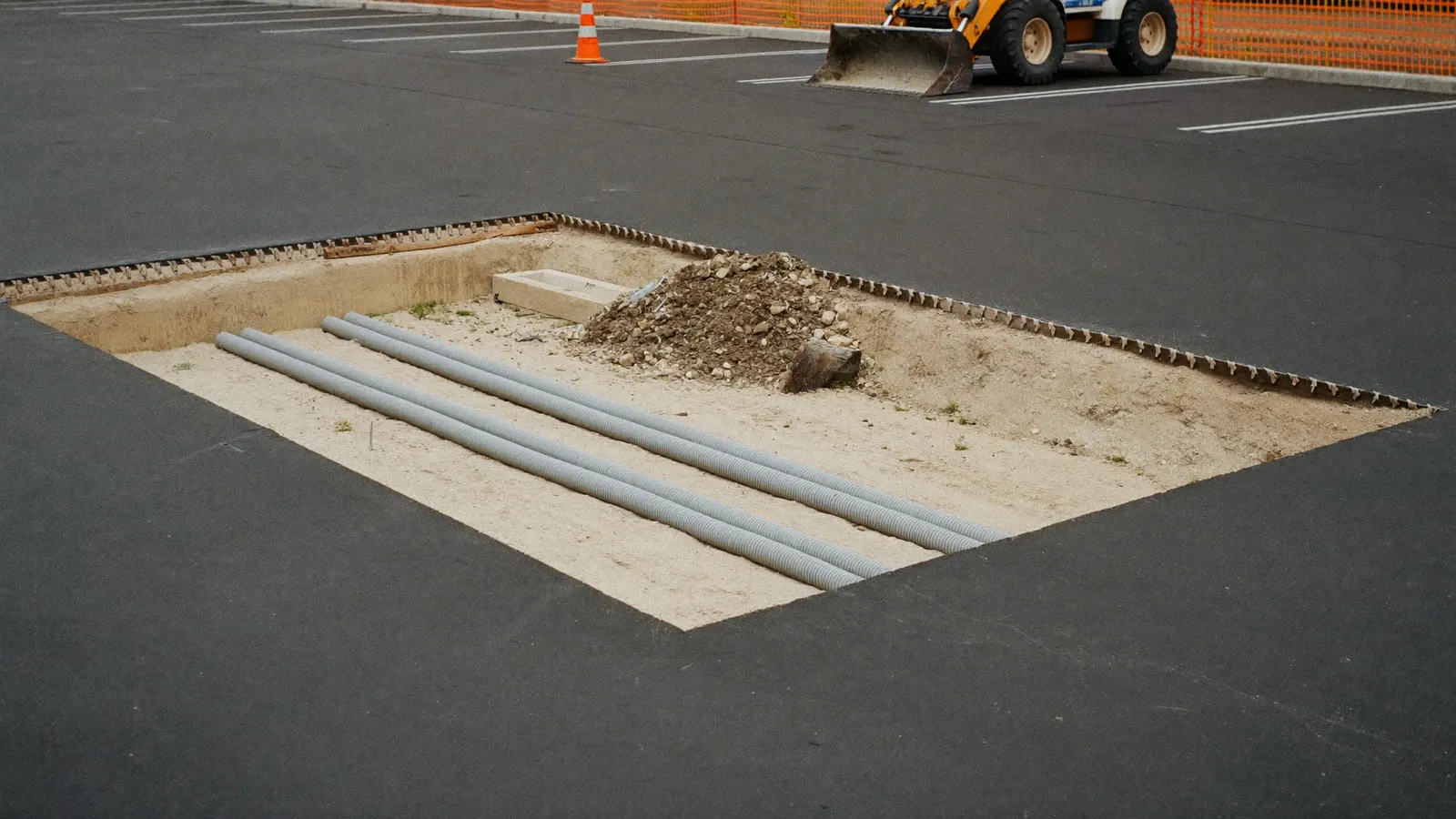
What you are actually paying for
Almost none of a trenching bill is the act of digging. It is mobilisation, saw cutting, spoil removal, bedding sand, conduit, compaction, restoration, traffic control and the day the crew loses to a utility locate that came back wrong.
Surface and restoration decide the price
Rank your route by what it crosses and you can predict the expensive segments before anyone quotes them.
| Surface crossed | Usual method | What restoration means | Relative cost |
|---|---|---|---|
| Landscape or turf | Open trench | Backfill, topsoil, reseed or replant, repair irrigation | Lowest |
| Asphalt parking bay | Saw cut, open trench | Compacted base, hot mix patch, seal, re-stripe | Moderate |
| Asphalt drive aisle or fire lane | Saw cut, often phased or after hours | Patch to the same spec, plus traffic control and phasing | Higher |
| Concrete paving or walkway | Saw cut to the nearest joints | Replace whole panels joint to joint, then cure | High |
| Structural or post-tensioned slab | Bore, scanned coring, or surface raceway. Not a saw cut. | Engineer sign-off before anything is drilled | Highest, and sometimes not permitted at all |
| Public street or a utility easement | Directional bore | Road authority permit, no surface to restore | Set by the permit, not by the footage |
Depth is set by code, not by preference
The reason a run under a parking lot costs more than a run under a lawn starts with cover: the code demands more of it under anything vehicles drive on.
| Where the run passes | Direct-buried cable | Rigid or intermediate metal conduit | PVC listed for direct burial |
|---|---|---|---|
| Under a parking lot, driveway, street or alley | 24 | 24 | 24 |
| General locations not listed below | 24 | 6 | 18 |
| In a trench below 2 in of concrete or equivalent | 18 | 6 | 12 |
| Under a 4 in exterior slab with no vehicular traffic, slab extending 6 in beyond the run | 18 | 4 | 4 |
| Under a building | Raceway only | 0 | 0 |
The four-way decision
Before anyone prices a trench, price the alternatives to it. There are four ways to get power across a property and open trenching is only sometimes the cheapest.
Pull spare conduit while the trench is open
The trench, not the conduit, is the asset. The marginal cost of adding ducts to a trench already dug is small, and the cost of digging the same route again is the entire bill a second time.
What to demand in the quote
Ask for the civil work broken out, and the quote becomes comparable between bidders instead of a single number you cannot interrogate.
How much does it cost to trench for EV chargers in a parking lot?
There is no honest national per-foot figure, and we are not going to publish one. The cost is dominated by what surface is cut and to what standard it must be restored, both of which are local. What you can do is get the quote broken into linear feet by surface type, restoration specification, and traffic control, at which point two bids become comparable and the expensive segment becomes obvious.
Is directional boring cheaper than open trenching?
Often, once restoration is in the comparison. Boring costs more per foot and disturbs almost nothing between the entry and exit pits, so it wins across drive aisles, concrete, mature landscaping and anything the property cannot close. On a short run through soft ground with a cheap surface, open trenching still wins.
Can conduit run overhead instead of underground?
On carports, canopies, parking structures and building walls, frequently yes, and it can remove the civil work from the project entirely. The constraints are clearance above vehicles and walkways, support spacing, the raceway's exposure rating, and whether the property will accept the appearance. It is always worth asking before a trench is priced.
How deep does conduit for EV chargers have to be buried?
Under a parking lot, driveway, street or alley the NEC's cover table calls for 24 inches regardless of wiring method. In general locations it is 24 inches for direct-buried cable, 18 for PVC listed for direct burial and 6 for rigid or intermediate metal conduit. The table has been renumbered across editions, so the operative version is the edition your jurisdiction adopted.
How much spare conduit should we install?
Think in ducts rather than in ports. Decide the port count you would plausibly reach at full adoption, put conduit in for that, and populate hardware as drivers appear. The right amount of spare is the amount that means nobody has to cut this lot again, because the second cut costs full price and inherits a restoration standard you will not enjoy.
Who pays for trenching in a leased property, the landlord or the tenant?
That is a lease question rather than an electrical one, and it turns on whether the work is treated as a capital improvement to the property or a tenant improvement. Settle it before design, and settle the restoration standard in the same conversation, because the party who owns the pavement usually has strong views about how it gets put back.
See what the civil work does to your number
The estimate asks for run distance and what the run crosses, because those two answers move a commercial charging budget more than the hardware selection does. It takes about a minute and it gives you a range you can hold a bid against.