Can You Install an EV Charger With Knob-and-Tube Wiring?
Yes, but not on the knob-and-tube circuit itself. NEC Article 625 defines EV supply equipment as including an equipment grounding conductor, and knob-and-tube never has one, so the charger gets a new dedicated circuit run in modern grounded wire regardless of what feeds the rest of the house. The knob-and-tube elsewhere in the house is a separate problem, and for most homeowners it is a bigger one for their insurance policy than for the charger.
Updated 2026-08-25
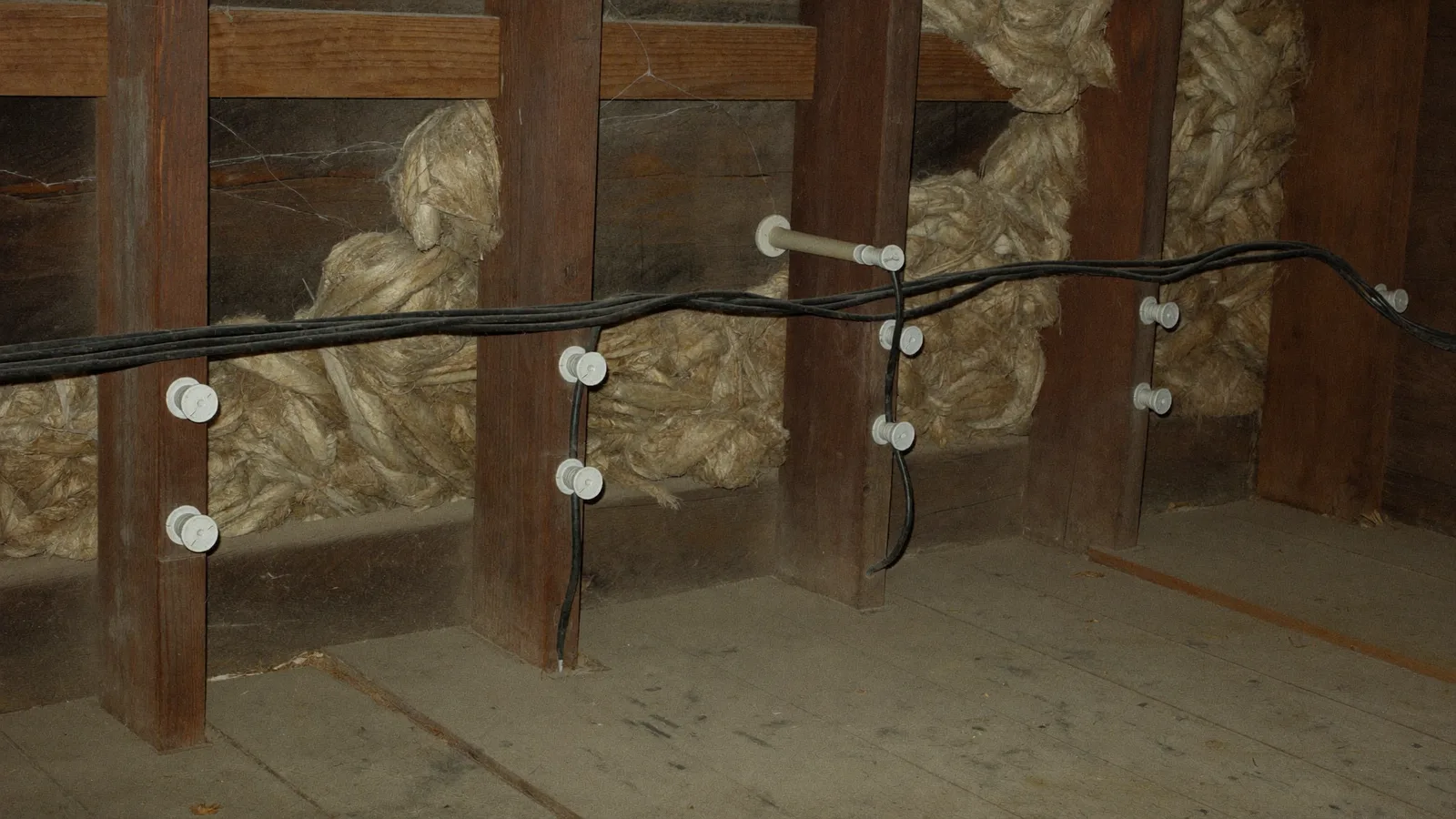
Knob-and-tube disqualifies itself as the charger circuit, not the house
No electrician is going to land your EV charger on an existing knob-and-tube circuit, and the reason is narrower than "it's old." NEC Article 625 defines Electric Vehicle Supply Equipment as including the ungrounded conductor, the grounded conductor, and the equipment grounding conductor, as one system. Knob-and-tube is a two-wire system with no equipment grounding conductor at all. It was never built to have one, because the code that requires one for branch circuits didn't exist yet when most knob-and-tube went into houses.
That single fact settles the question by itself. Whatever else is true about your panel, your service size, or how old the house is, the wire that actually feeds the charger has to be able to carry an equipment ground, and knob-and-tube structurally cannot. The electrician runs new cable or conduit from the panel to the charger location. The knob-and-tube stays exactly where it is, doing exactly what it was doing before you bought the car.
Why the trick that saves an old lamp outlet doesn't save this circuit
It doesn't, because an EV charger isn't a lamp. NEC 406.4(D)(2)(b) lets an electrician replace an old two-prong, non-grounding receptacle with a GFCI-type receptacle on an ungrounded circuit, as long as it's marked "GFCI Protected" and "No Equipment Ground." That's a normal, legal, common repair in a knob-and-tube house, and it's the reason people sometimes assume the same trick clears an EV circuit.
It doesn't transfer, because a GFCI protects a person from shock current leaking to ground. It does nothing to supply the equipment grounding conductor that the EVSE's own listing and NEC 625.2 require as part of the equipment. A charger is permanently connected apparatus with control electronics and a metal enclosure, not a lamp plugged into a wall. There's no code allowance that swaps a GFCI in for the ground path an EV charging circuit is defined to include.
| Load | Can a GFCI stand in for the missing ground? | Why |
|---|---|---|
| Old two-prong receptacle, lamp or small appliance | Yes — NEC 406.4(D)(2)(b) | A receptacle replacement, not new equipment defined to include a ground path |
| EV charger branch circuit | No | NEC 625.2 defines EVSE's conductors as including the equipment grounding conductor as part of the equipment itself |
The second problem: knob-and-tube can't carry the load anyway
Even ignoring the grounding question, an original knob-and-tube circuit is rated for far less current than a Level 2 charger draws. Knob-and-tube branch wiring is typically solid #14 or #12 copper with rubber-and-cotton insulation, which is a 60°C-rated conductor, and NEC Table 310.16's 60°C column is what its ampacity is figured on. In practice that means most knob-and-tube branch circuits are protected at 15 amps, with some heavier runs at 20 amps — sized for the lighting and small-appliance loads of the house's original era, not for a single continuous 240-volt load.
A Level 2 charger set to even a modest 16 amps is a continuous load, so under NEC 210.20(A) the circuit has to be sized at 125 percent of that, which already exceeds a 15-amp knob-and-tube circuit before you consider anything else. There is no charger setting low enough to make this work, because the code doesn't let you extend knob-and-tube into new general-purpose circuits in the first place: NEC 394.10 permits concealed knob-and-tube only for extensions of an existing knob-and-tube installation, or elsewhere by special permission. A new EV circuit is neither.
| Typical knob-and-tube branch circuit | 16 A Level 2 charger (the lowest common setting) | |
|---|---|---|
| Conductor | Solid #14 or #12 copper, rubber/cotton insulation | Dedicated new conductor, sized to the breaker |
| Ampacity basis | NEC Table 310.16, 60°C column | Sized per NEC 625 and the continuous-load rule |
| Typical overcurrent protection | 15 A, sometimes 20 A | 20 A minimum, most home chargers set higher |
| Continuous-load requirement | Not designed for one | Breaker sized at 125% of the charger's rated current |
What actually happens at your panel
An electrician runs a new circuit and leaves your knob-and-tube alone — unless it's already touching something it shouldn't. Adding a breaker for the EV circuit means working inside a panel that may also feed several knob-and-tube branch circuits. A competent electrician isn't going to rewire those on the spot as part of an EV job you didn't ask for, and shouldn't fold a whole-house rewire into the charger quote without saying so first.
What they will flag, because it's their job to, is anything already wrong: a knob-and-tube conductor buried in blown-in or rolled attic insulation, a splice outside a junction box, or a knob broken off its stand-off. NEC 394.12(5) prohibits knob-and-tube in hollow walls, ceilings or attics where the space is insulated with loose, rolled or foamed-in-place material that envelops the conductors — the wiring relies on open air to shed heat, and insulation packed around it traps it instead. If a previous owner blew insulation into an attic with knob-and-tube already up there, that's a code violation that predates the EV project, and it's worth having them look while they're already up in the attic running your new circuit.
The part that's a bigger deal than the electrical work: insurance
This is the piece most people researching a knob-and-tube house miss, because the EV circuit itself is a solved problem and the insurance status of the house is not. Most standard homeowners carriers decline to write a policy on a home with active knob-and-tube wiring at all, and the specialty carriers that will write one price the risk into the premium. Mark Friedlander, senior director of media relations at the Insurance Information Institute, has pointed to a specific reason this compounds over time: as older homes get renovated, knob-and-tube frequently ends up buried in insulation and pressed against other building materials — the same NEC 394.12(5) condition above, described from the insurer's side of the desk.
None of that changes because of the EV charger. A house could get a flawless, permitted, fully grounded EV circuit installed and remain just as uninsurable on the knob-and-tube grounds as it was before, because the underwriting question is about the house's electrical system generally, not about any one circuit. That also runs the other direction: pulling the permit for the EV work is a normal moment to ask your agent or carrier directly what their position is on the knob-and-tube already in the house, since you'll have an electrician's eyes on the panel anyway.
Carrier positions vary by company and by state, and there's no national rule here — anyone telling you flatly that your policy is fine, or flatly that it's dead, is guessing. Ask your own carrier, get the answer in writing, and if you want a non-commercial second opinion on how insurance is regulated in your state, your state insurance department and the National Association of Insurance Commissioners' directory are the places that route you to it.
Do you have to remove all the knob-and-tube to get the charger?
No. The code requirement is on the new EV circuit, not on the rest of the house's existing wiring, so nothing about adding a charger forces a whole-house rewire by itself. The knob-and-tube elsewhere keeps operating under whatever rules let it stay in service in the first place, exactly the way the rest of an old house's wiring does when any single new circuit gets added.
What can push you toward a bigger project isn't the charger, it's everything else stacked on top of it: an insurer that won't bind a policy until the wiring is updated, a lender flagging it during a purchase or refinance, or an electrician finding a knob-and-tube run already buried in insulation while they're up in your attic for the EV job. Any of those is worth pricing on its own, as its own decision, separate from the charger circuit — the same way a panel replacement or aluminum-wiring remediation gets priced separately from the EV work that happened to surface it.
Is knob-and-tube wiring safe for an EV charger?
No, not as the circuit that feeds the charger. It has no equipment grounding conductor, which NEC 625.2 requires as part of the EV supply equipment, and its typical 15 or 20-amp rating is far below what a Level 2 charger needs as a continuous load. The charger gets its own new, grounded circuit instead.
Does homeowners insurance cover EV chargers with knob and tube wiring in the house?
There's no national rule, and it depends on your carrier and state. What's well documented is that most standard insurers decline to write a policy on a home with active knob-and-tube wiring at all, regardless of the charger, and specialty carriers that will cover it price the risk into the premium. Ask your own carrier and get the answer in writing.
Do I need to upgrade my knob-and-tube wiring before installing an EV charger?
Not because of the charger — code requires the new circuit to be modern and grounded, not the rest of the house's wiring. You may still need to upgrade it because of your insurer or a mortgage lender, which is a separate decision from the electrical work the charger itself requires.
Can an electrician run a new circuit for my EV charger if the rest of my house has knob-and-tube wiring?
Yes. The new circuit is run in modern cable or conduit from the panel to the charger and doesn't connect to the existing knob-and-tube branch circuits. The old wiring keeps doing what it was doing before.
What's the maximum amperage on a knob-and-tube circuit?
Most knob-and-tube branch circuits are protected at 15 amps, with some heavier runs at 20 amps, based on the 60°C column of NEC Table 310.16 for its rubber-and-cotton-insulated conductors. That's well under what a Level 2 EV charger needs even at its lowest common setting.
Will an inspector fail my EV charger permit because the house has knob-and-tube wiring elsewhere?
Not for wiring the permit isn't touching. The inspection covers the new EV circuit against current code. If the inspector notices knob-and-tube already in contact with insulation or otherwise visibly compromised while they're in the attic or panel, expect that flagged as its own issue, separate from the EV permit passing or failing.
Can I use a GFCI to make a knob-and-tube circuit safe enough for an EV charger?
No. A GFCI-protected, marked "No Equipment Ground" receptacle is a legal fix for an old two-prong outlet under NEC 406.4(D)(2)(b), but an EV charger isn't a receptacle load — it's equipment that NEC 625.2 defines as including an equipment grounding conductor. There's no code path that substitutes a GFCI for that.
Is knob-and-tube wiring illegal?
Existing knob-and-tube is generally allowed to remain in service where it was legally installed; most jurisdictions don't require it be torn out on its own. What the NEC restricts is extending it — concealed knob-and-tube is permitted under NEC 394.10 only for extensions of an existing knob-and-tube installation or by special permission, never as wiring for new circuits like an EV charger.
The ampacity, era and clearance figures on this page are sourced code convention and industry history, not a measurement of any specific house. Whether your particular knob-and-tube system is safe to leave in place, and what your carrier will actually do, are questions for a licensed electrician and your own insurer, not a web page.
Price the new circuit, not the old wiring
Tell the estimate tool your panel type and the age of the house, and it prices the dedicated, grounded circuit an EV charger actually requires — separate from anything your knob-and-tube wiring might need on its own.