Should you buy a Tesla Wall Connector for a non-Tesla?
Yes, if you order the version with the right connector. This is a spec-sheet question, not a brand question: the standard Wall Connector ships with a NACS cable that will not plug into a J1772 inlet, and Tesla's Universal Wall Connector solves that with an integrated J1772 adapter. Once installed, it's an ordinary Level 2 charger. For a two-car household the feature that usually decides it is power sharing, which lets several units of the same family run from one circuit.
Updated 2026-08-20
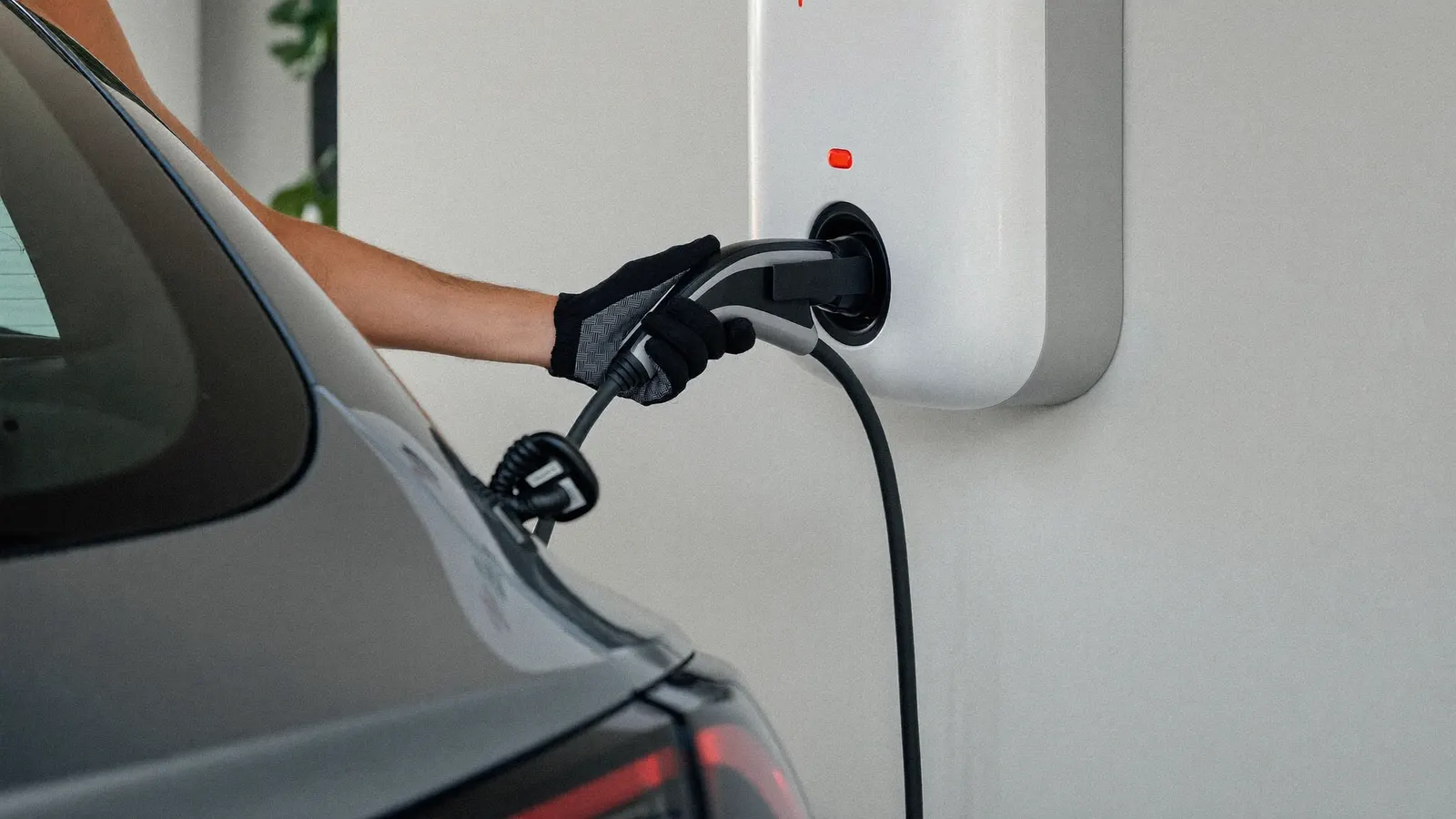
Verify three things before you order
Every argument about whether a Tesla charger belongs in a non-Tesla garage collapses into three checks. None of them is about the badge.
First, the connector as shipped. A charger comes with a fixed cable and a fixed plug on the end of it. NACS, the Tesla-style connector now standardised as SAE J3400, does not fit a J1772 inlet. If your car has a J1772 inlet, you need a unit whose cable ends in J1772 or a unit the manufacturer supplies with an adapter for that direction.
Second, adapter support, and specifically the direction. The adapter that came in your Tesla-owning neighbour's trunk goes the other way — it lets a Tesla use a J1772 station. It does not let a J1772 car use a NACS cable. Third-party adapters for the direction you need exist; whether the charger manufacturer and the vehicle manufacturer support them is a question with real warranty and liability consequences, and the clean answer is to buy the right cable rather than to adapt the wrong one.
Third, whether the unit is listed for where you want to mount it. A charger is listed by a testing laboratory for particular conditions, and the installation manual is what the electrical inspector reads. Outdoor mounting, indoor mounting, ambient temperature range and mounting height all appear in that document, and they govern regardless of what a review video shows.
| Check | Where the answer is | If you get it wrong |
|---|---|---|
| Connector on the cable as shipped | Manufacturer product page and datasheet | The charger physically will not connect to your car |
| Adapter support, in the direction you need | Manufacturer support documentation, not a marketplace listing | It may work and may void a warranty; failure mode is heat at the joint |
| Listing for the mounting location | Installation manual, which the inspector reads | A failed inspection after the conduit is already run |
| Maximum output and required breaker | Datasheet | An install that is either slower than expected or larger than the panel can take |
| Power sharing group size | Manufacturer support documentation | A second circuit you did not need to pay for |
What the current lineup looks like
Tesla sells more than one hardwired charger, and the relevant difference is the cable. The standard Wall Connector ships with a NACS cable only, and will not plug into a J1772 inlet on its own. The Universal Wall Connector is the version built for a mixed garage: it carries a NACS cable with an integrated J1772 adapter and is rated to 11.5 kW at 48 amps, which is the top of the residential Level 2 range. If any car in the household uses J1772, the Universal is the one to order, not the standard model.
Tesla's shop listed the Wall Connector at $535 and the Universal Wall Connector at $600 as of 2026-08-20; hardware pricing moves, so treat those as a snapshot, not a quote. Product lines change and part numbers get retired. Confirm the current lineup and the current datasheet on the manufacturer's own page before you order, and give your electrician the model number rather than a product name, because the breaker size and the conductor size come from the datasheet.
The feature that usually decides it: power sharing
This is the argument that has nothing to do with brand loyalty and everything to do with the price of a second circuit. Tesla's third-generation Wall Connectors support power sharing across a group — up to six units on shared power, per Tesla's own documentation, with the second-generation units supporting up to four. The group divides a fixed amount of power between whichever cars are actually charging.
For a two-car household that matters, because the alternative is two full-current circuits. Two 60-amp circuits is 120 amps of allocated capacity on a service that may not have it, plus a second conduit run to a second location. One shared circuit feeding two units is one trench, one set of conductors, one breaker, and a load your panel is far more likely to accept as it stands.
The trade is speed on the nights both cars charge hard, and it is usually not a real trade. Two cars sharing 48 amps overnight still take on more range each than a typical day consumes. This is the same logic that makes load management a better answer than a service upgrade in most houses.
The catch is that power sharing works within a manufacturer's own family. Mixing brands on one shared circuit is not a thing you can assume. If you intend to share, buy both units from the same family at the same time, and tell your electrician before they size anything.
Amperage, breakers and what each one actually delivers
The number that decides charging speed is the charger's output current, and the number that decides whether your panel can take it is the breaker, which is larger. EV charging is treated as a continuous load, so the branch circuit and its overcurrent device are sized at 125 percent of the charger's rated current. A 48-amp charger occupies a 60-amp breaker whether a car is plugged in or not.
That is the real cost of buying the fastest unit. It is not the hardware price, it is the 60 amps of service capacity you have to find.
| Charger output | Circuit and breaker | Power delivered | Range added per hour |
|---|---|---|---|
| 16 A | 20 A | 3.8 kW | 11 – 14 miles |
| 32 A | 40 A | 7.7 kW | 23 – 29 miles |
| 40 A | 50 A | 9.6 kW | 29 – 36 miles |
| 48 A | 60 A | 11.5 kW | 35 – 44 miles |
Where the badge does matter, a little
Two honest points in favour, neither of them decisive. The Wall Connector line is hardwired rather than plug-in, which is generally the better outdoor arrangement and supports higher continuous current than a plug-in unit on a 14-50 receptacle can. And a garage with one Tesla and one non-Tesla is exactly the case power sharing was built for.
Two honest points against. A hardwired unit is an electrician visit if you ever want to remove or replace it, which matters if you might move. And buying into one manufacturer's power-sharing ecosystem is a commitment for the next unit as well as this one.
What should not enter the decision is the connector on the car you might buy in five years. Vehicles from most manufacturers are moving to NACS inlets, cables are the cheapest replaceable part of an installation, and the circuit behind the charger is connector-agnostic. Spend the thought on the circuit.
The question your electrician needs answered
Bring three facts to the quote: the model number of the unit you intend to buy, whether you are installing one or planning to share power between two, and where each car parks. Those three decide the breaker, the conductor size and the length of the run, which are the whole of the price.
If you have not chosen hardware yet, say so. Sizing the circuit for the unit you eventually want costs almost nothing while the conduit is open and is expensive to revisit afterwards.
Can I use the J1772 adapter that came with a Tesla on a Tesla Wall Connector?
No. That adapter converts a J1772 plug so a Tesla can accept it, which is the opposite direction. To charge a J1772 car from a NACS cable you need an adapter that goes NACS to J1772, and the supported way to get that is a unit the manufacturer ships with one, such as the Universal Wall Connector.
Is a Tesla Wall Connector cheaper than other Level 2 chargers?
Hardware pricing moves and is not the decisive number anyway. On a typical home install the charger is a few hundred dollars of an $800 to $3,000 job, so a hardware price difference of a hundred dollars is noise next to the run length and the state of your panel.
Do I need two circuits for two EVs?
Not necessarily. Two units from the same manufacturer family that support power sharing can run from one circuit and split the available power between whichever cars are charging. Overnight that is rarely a real constraint, and it can be the difference between fitting on your existing service and paying for an upgrade.
Does a hardwired charger need a disconnect switch?
It depends on the rating and on your jurisdiction. NEC Article 625 requires a disconnecting means for permanently connected equipment above certain ratings, installed in a readily accessible location and lockable in the open position. Which editions and amendments apply is a local question, and it is one your electrician answers by naming the adopted code cycle, not by guessing.
Will a NACS charger work with a future car?
Most manufacturers selling in North America have committed to NACS inlets on new vehicles, so a NACS cable is a reasonable bet — but the cable is the cheap, replaceable part. Size the circuit properly and the connector question stays a small one for the life of the installation.
- Tesla — Wall Connector power management and power sharing group sizes
- Tesla Shop — Universal Wall Connector (integrated J1772 adapter, 11.5 kW / 48 A; listed at $600 as observed 2026-08-20)
- Tesla Shop — Chargers section, listing the Wall Connector ($535), Universal Wall Connector ($600) and Mobile Connector ($300); prices as listed on Tesla's shop page, 2026-08-20
- Installed-cost ranges: Qmerit, home charging installation costs
Pick the hardware last. Price the circuit first.
Tell us where each car parks, roughly how far that is from your panel and whether you want one unit or two sharing a circuit. You get an installed-price range for the work, which is the part the hardware choice barely moves.