EV charger in a detached garage: what the trench actually costs
A detached-garage Level 2 install models at $2,000 to $6,000, against $800 to $3,000 for the same charger on an attached garage wall. That is not one number with a trench added to it. It is three separate decisions — whether you run a feeder to a small subpanel or a single home-run circuit, which wiring method goes in the ground, and who puts the surface back — and the third one moves the price more than the distance does.
Updated 2026-08-20
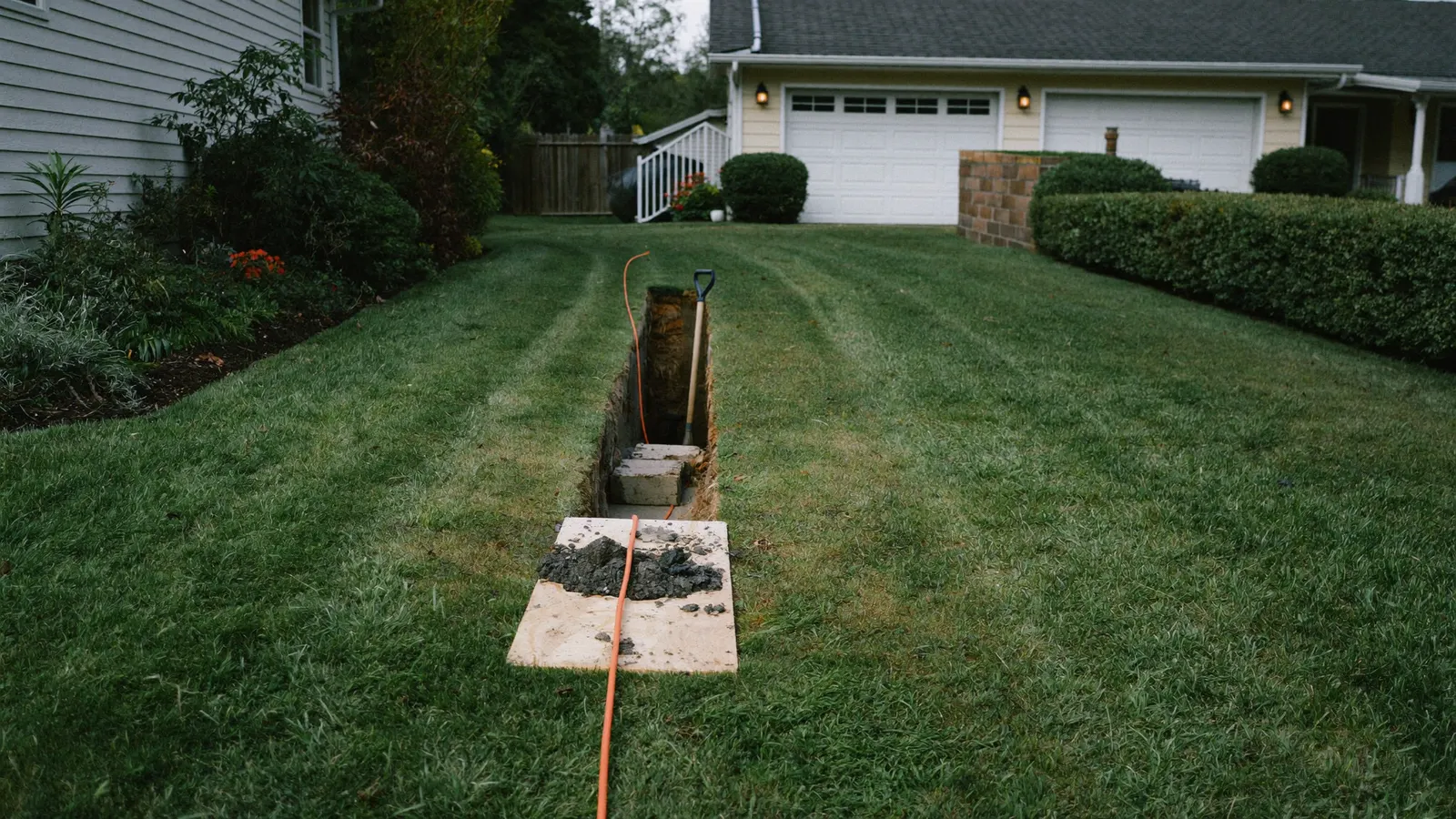
Decision one: a feeder and a subpanel, or one circuit
A single home-run circuit is one 240-volt branch circuit from the house panel to the charger. It is the cheaper thing to install today and it does exactly one job forever.
A feeder to a small subpanel in the garage costs more today — a panel, a disconnect, larger conductors — and then gives you lights, receptacles, a second charger later, and a place to land anything else the building ever needs. If the garage currently has no power at all, or has a 1970s lighting circuit, this is usually the better buy, because the trench is the expensive part and you only want to open it once.
There is a code reason to think about it now rather than later. Under NEC 225.30 a separate structure is generally supplied by a single feeder or branch circuit, with limited exceptions. So you do not get to run one circuit today and a second one next year and treat that as normal. Decide the building's total electrical future in one conversation.
Two more items belong to the outbuilding and show up on a correct quote: a disconnecting means at the structure (NEC 225.31 and 225.32) and a grounding electrode at the separate structure (NEC 250.32), fed by a four-wire feeder with the neutral and the equipment ground kept separate at the subpanel. If none of those words appear anywhere in a quote for a detached building, the bidder has not scoped it.
Decision two: the wiring method sets how deep you dig
Burial depth is not one number. NEC Table 300.5 sets a different minimum cover for each wiring method, because the protection comes from what is around the conductors, not from the dirt alone. Deeper trench means more excavation, more spoil to handle and more surface to put back, so this choice has a direct price consequence.
The values below are the ones for the table's general row — locations not otherwise specified. A run that crosses a driveway, a parking area or a public street falls into its own row with its own deeper minimum, and the row for a public street is deeper than the row for a driveway serving the house. Ask your electrician which row applies to your route.
| Wiring method | Minimum cover | What it means for the trench |
|---|---|---|
| Direct-buried cable or conductors | 24 in | Deepest trench, cheapest material. Often the wrong trade-off once you price the digging |
| Rigid metal conduit or intermediate metal conduit | 6 in | Shallowest trench, most expensive pipe and the most labour to assemble |
| Nonmetallic raceway listed for direct burial without concrete encasement (e.g. PVC) | 18 in | The common residential answer. Middle on both depth and material |
| Residential branch circuit, 120 V or less, GFCI protected, 20 A or less | 12 in | Does NOT apply to your charger. A 240-volt EV circuit cannot use this column |
That 12-inch figure people quote is not yours
The twelve-inch column in Table 300.5 is for residential branch circuits rated 120 volts or less, 20 amps or less, with ground-fault protection. It exists for landscape and outbuilding lighting. It is also the number that gets repeated on forums by people who never read the column heading.
An EV charger circuit is 240 volts and 40 to 60 amps. It gets the 24, 6 or 18-inch answer depending on the method. If a quote is priced against a twelve-inch trench, either the bidder has the wrong number or the run is not what you think it is.
Decision three: what you cross, which is the one nobody prices for you
This is the variable that separates a $2,500 job from a $5,500 job at the same distance. Digging a trench through lawn is cheap and the repair is a rake, some topsoil and seed. Digging one under a poured concrete driveway means saw-cutting, breaking out, hauling away, forming and pouring — a concrete job that happens to be attached to an electrical job, priced by a concrete crew, and it will very likely not match the colour of the slab beside it.
Between those two extremes sit pavers, which come up and go back down reasonably well; asphalt, which patches visibly; mature tree roots, which are slow and occasionally fatal to the route; and rock, which is the one nobody finds until the machine is on site.
There is a way around a hard surface: boring under it rather than cutting it. Directional boring or a simple push rod avoids the restoration entirely and is frequently cheaper than cutting and replacing concrete. Ask whether the bidder can bore. Not all of them can, and the ones who can often do not mention it unless asked.
The other honest reason to ask about route length rather than straight-line distance: a route that keeps to grass and skirts the driveway may be forty feet longer and several thousand dollars cheaper.
Where the money actually goes
Set against the attached-garage baseline so you can see what the outbuilding is really costing you.
| Scope | Modelled installed range | What decides where you land |
|---|---|---|
| Level 2, attached garage, panel on the same wall | $800 – $3,000 | Little. This is the floor for a residential job |
| Level 2, attached garage, long run or panel work | $2,000 – $4,500 | Run length, route, and whether the panel needs anything |
| Level 2, detached structure with a trench | $2,000 – $6,000 | Subpanel vs single circuit, wiring method, and surface restoration |
| Service upgrade, if the load calculation requires one | $1,500 – $3,000 electrical work | Utility service drop, meter base and grounding system. Panel itself is $500 – $5,000 |
| Permit | $50 – $800 | Your jurisdiction. Nothing about your job |
If the garage already has power, find out what kind
Before anyone prices a trench, find out the size of the existing feed and how it was run. A 20-amp lighting circuit will not carry a charger and cannot be upgraded in place. A 60-amp feeder to a small subpanel might carry a 32-amp charger comfortably, which turns a $4,000 job into a much smaller one.
Reusing an old trench only helps if the existing conduit is large enough for the new conductors and is in good enough condition to pull through. Direct-buried cable cannot be reused as a raceway at all — there is nothing to pull through. Have the electrician look before you plan around it.
Before anyone digs
Call 811 first. It is the free national one-call service that gets your buried utilities located and marked, it is required in every US state before excavation, and hitting a gas line or a fibre drop is a much worse day than the trench you were digging. The locate is free; the notice period is usually a couple of business days, which is worth putting on the calendar before you book the electrician.
One scheduling detail that catches homeowners who dig their own trench: the inspection generally happens on the open trench. If you backfill before the inspector sees it, you may be digging it out again.
Can I dig the trench myself to save money?
Often yes, and some installers will price the job either way. Two conditions: call 811 and let the locate happen first, and leave the trench open until it has been inspected, because the inspection is generally performed on open ground. Confirm the depth and the route with the electrician before you start — a trench dug to the wrong depth for the wiring method they intended to use is worse than no trench.
Do I need a subpanel in the detached garage?
Not always, but usually worth it. NEC 225.30 generally allows one feeder or branch circuit to a separate structure, so if you run a single charger circuit today, adding lights and outlets later is not a simple second run. A small subpanel spends a bit more now and settles the building's electrical future while the trench is open.
How deep does the conduit have to be?
It depends on the wiring method. Under NEC Table 300.5, the general row calls for 24 inches over direct-buried cable, 18 inches over nonmetallic raceway listed for direct burial, and 6 inches over rigid metal or intermediate metal conduit. Crossings under driveways, parking areas and streets have their own deeper rows. The 12-inch figure people quote applies only to 120-volt, 20-amp GFCI-protected residential circuits, which an EV charger is not.
Does the detached garage need its own ground rod?
A grounding electrode is generally required at a separate structure under NEC 250.32, and the feeder is run with four conductors so the neutral and the equipment ground stay separate at the subpanel. This is one of the places where a quote written for an attached garage quietly does not cover the job. Your AHJ has the final say.
Is it cheaper to put the charger on the house wall and run a long cable to the garage?
Usually not, and it may not be permitted. EVSE cord lengths are limited by the equipment listing and by code, and draping a charging cable across a driveway creates a trip hazard and a damaged cable. If the car parks at the detached garage, put the charger there. If it parks on the driveway between the two, mounting on the house wall near the driveway is a genuinely cheaper option worth pricing.
Can I go under the driveway instead of cutting it?
Frequently, yes. Boring or pushing a conduit under a hard surface avoids saw-cutting, removal and replacement, and it is often cheaper than the concrete work it replaces. Not every residential electrician has the equipment, so ask specifically rather than waiting for it to be offered.
Installed ranges are the site's modelled national bands from Qmerit and HomeAdvisor. Burial depths are from NEC Table 300.5; your adopted code edition and your AHJ govern.
- Why EV charger quotes vary so much for the same charger
- Long runs: what the distance between panel and charger costs
- Adding an EV charger during a panel upgrade
- Does an EV charger add value when you sell?
- No spare breaker spaces: what your options actually are
- See how this scenario compares to the others
Price your own trench
The estimate tool asks where the car parks, how far that is from the panel and whether the run goes underground, because those three answers are most of the number. It takes about two minutes and gives you a modelled range before anyone comes out.